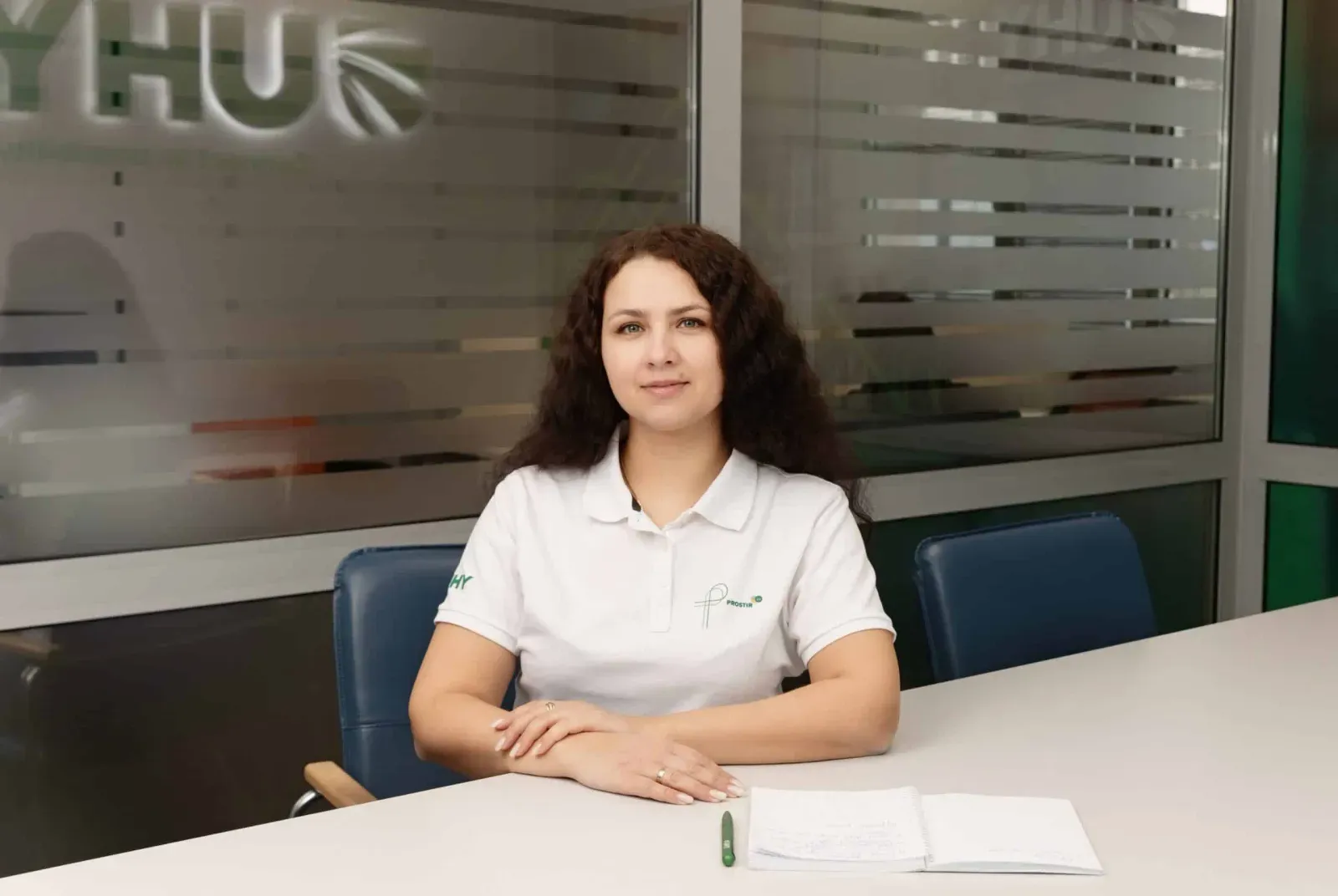
Professional growth in outsourced accounting comes with years of practice, but much deeper things define it: responsibility, systems thinking and the ability to see the real consequences for the business behind the numbers. With this approach, a professional can move from simply doing technical tasks to being a partner for the client and a source of support for the team.
In this interview, Larysa Sterniuk, an expert with many years of experience at UHY Prostir, talks about her career path, how the accountant’s role has changed, managing a team and the personal qualities without which real growth in the profession is impossible.
How did your career in accounting begin, and how did you join UHY Prostir?
I chose my professional direction right after school, when I entered university to study Accounting and Auditing. It was partly a conscious choice and partly my family’s influence, as my mother also worked as an accountant. At the same time, I was always interested in economics and finance, and this degree gave me a broad base of knowledge, from accounting to understanding business processes in general.
While studying, I worked in different fields, and this experience helped me become more independent. After my fourth year, I decided to find a job in my own field. Then I saw an opening for an assistant accountant at UHY Prostir, went through several selection stages and joined the team. At first the job was part-time, because I was still doing my master’s degree, but over time the work became my main focus. I have been with the company since September 2011, and this year marks 15 years of my professional path with UHY Prostir.
Today you work as a project manager. How did this stage of your career develop?
The move to the project manager role was gradual. Before that, I worked as an accountant and as a chief accountant on client projects. I was deeply involved in all processes, from day-to-day operations to preparing reports and communicating with clients. Over time, the company grew, the team expanded, and it became clear that the work needed a different structure.
Then the company decided to introduce a project management system: to divide clients between teams and to appoint people responsible for coordinating the processes. I was offered the chance to try this role, and I agreed. It was a new stage that required a different focus. Deep knowledge of accounting was no longer enough: I also had to organize the team’s work and distribute the workload. I had to control deadlines and quality and stay in constant contact with clients.
How do you see the difference between keeping the books as a technical function and building a system that becomes a tool for management decisions?
To put it simply, “just keeping the books” means recording business events: receiving documents, entering transactions in the accounts and preparing reports. This is an important part of the work, but it only reflects what has already happened.
An accounting system that works for the business starts much earlier, when decisions are being made. Here it is not enough to record a transaction. You need to analyze its impact on taxes, profitability, risks and the long-term outlook. For example, the choice of an accounting policy or of methods for writing off inventory and calculating depreciation is not a formality. These decisions determine what the financial result will look like and what consequences may arise in the future.
Such a system also includes a properly organized document flow, correct analytics and a clear structure of expenses and income. When accounting is built as a system, the manager does not just see numbers but understands where they come from and what can be influenced. Then the accountant is no longer someone who performs technical tasks but a partner who helps make well-founded decisions.
Which aspects of accounting do businesses most often underestimate until they face real risks or financial consequences?
Most often, businesses underestimate how important a well-chosen accounting policy is. It seems to be a technical decision with no strategic importance. In fact, the methods of writing off inventory, the approach to depreciation of fixed assets or the structure of analytics directly affect the financial result and the tax burden. If these decisions are made without taking the specifics of the business into account, they later have to be corrected, and this is difficult and painful.
Another underestimated area is documentation. While everything runs smoothly, it seems enough that a transaction actually took place. But during checks by the authorities or an audit, properly prepared documents become the key factor. Every item of income and every expense must be supported by documents. A missing contract, acceptance certificate or internal order can lead to tax risks and fines.
Businesses also sometimes do not pay enough attention to analyzing transactions before they take place. Some transactions may have additional tax consequences or affect the company’s status, for example, in matters of VAT or work with non-residents. If these risks are not analyzed in advance, the consequences may appear much later, when it is harder to change anything.
Do you see a difference between what Ukrainian and international clients expect from accounting services? How does it show?
Yes, the difference is noticeable. It comes mainly from the context in which they do business. Ukrainian companies that have been in business for a long time usually know the local requirements well. They understand the specifics of tax legislation, the level of bureaucracy and the documentation requirements. That is why their expectations are more often about speed, accuracy and stable processes.
International clients entering the Ukrainian market have different needs. For them, correct accounting is not enough: they also need deep expertise in local legislation. They expect the accountant to act ahead of time: to explain the requirements for documents, warn about tax risks and point out the details of communication with government authorities. In fact, this is an advisory role. The accountant does not just record transactions but assists the business in adapting to the Ukrainian regulatory environment.
That is why expertise and a proactive approach become much more important when we work with international companies. It is not enough to do your part of the work. You also need to give clients confidence that their operations meet all local requirements and that the risks are kept to a minimum.
How do you organize the team’s work when you manage several projects at the same time, with different types of clients and different levels of complexity?
The key principle is a clear division of responsibility. Each project has its own responsible accountant, in effect the lead accountant for that client. This person knows the client’s business in depth, understands its processes and is responsible for the quality and timeliness of the work.
When possible, an assistant also joins the project and takes over the operational part of the work. This gives the accountant more time for analysis, reporting and communication with the client, and it gives the assistant a chance to grow professionally.
My role as project manager is to keep the work systematic. I control deadlines and the quality of processes, help distribute the workload and join in when complex or unusual issues come up. It is important for me not to go into every operational detail but to keep an overview of the work as a whole: to identify risks, coordinate resources and support the team.
How do you support the team during periods of heavy workload or when difficult, unusual cases come up?
First of all, through open communication. It is important that people in the team do not keep problems to themselves. If a difficult case comes up or someone feels overloaded, we discuss it right away. I believe it is better to discuss a problem at the start than to solve it later in emergency mode. When it comes to difficult professional questions, we work through them together. If I see that a situation needs wider expertise or carries potential reputational risks, I involve management, because no one should be left alone with a problem.
During peak periods, the right distribution of resources helps. We can redistribute tasks within the team or bring in colleagues from other teams. This internal “outsourcing” takes off some of the pressure and helps us complete urgent tasks without any loss of quality.
It is also important to me that everyone feels supported, not only at work but also emotionally. Sometimes it is enough just to talk, break a difficult task into stages and show that it can be managed. In most cases, the feeling that you are not alone in a difficult situation already reduces the stress a lot.
How do you restore your energy after difficult or emotionally exhausting projects? What helps you get your balance back?
First of all, it is the sense of completion. When a difficult case is closed and a solution is found, simply knowing the result already gives me inner relief. If the situation was resolved professionally and with minimal risks for the client, it brings not only peace of mind but also satisfaction with the work.
Change also helps me: new projects, new tasks, a different format of work. When something different, interesting and unusual comes along after a period of intensive work, it gives me fresh motivation and brings back my professional interest.
And, of course, rest is important. It includes active time, such as travel, meeting friends and new experiences, and also quiet days without plans, when I can stop thinking about work, watch a film or just do nothing.
What do you think are the key factors of a team’s stability in the long term?
For me, team stability is above all a two-way process. On the one hand, the manager’s position matters: seeing how a person is developing, noticing their growth and giving them more responsibility or new tasks at the right time. Team members should feel that their work is noticed and valued and that they have room to develop.
On the other hand, the openness of the team itself is important. If someone feels tired, has doubts or wants to move on, they need to talk about it. When people stay silent, the company often loses strong professionals. When there is a dialogue, a solution can be found: change the work format, expand the area of responsibility, offer a new project or a different level of tasks.
Stability also directly depends on an atmosphere of trust. When people are not afraid to ask questions, talk about difficult situations and take responsibility, the team works much more effectively. And, of course, everyone needs room for professional growth. Without it, there is no long-term motivation.
How do you make difficult decisions when none of the options is perfect and you have to choose between several workable ones?
In such situations, I first analyze the consequences of each option, both short-term and long-term. Sometimes a decision that looks simpler “here and now” may create additional risks in the future. That is why it is important to weigh all the pros and cons and understand which option will be the safest and most effective for the client.
If the issue is complex or carries potential risks, I do not make the decision alone. Discussing it with a manager or colleagues helps me see the situation more broadly. Often a different point of view helps find a detail that was not obvious at first.
When a decision concerns the client, it is important to explain the possible consequences of each scenario openly. We explain the risks and how events may develop, and then the client makes the final decision with all the information they need. My area of responsibility is to give an expert assessment and make sure the choice is as well-founded as possible.
What is your main measure of effectiveness at work: financial results, client feedback or other criteria?
For me, effectiveness cannot be reduced to one indicator. Financial results are important, as they show the stability and growth of projects. But numbers alone do not give the full picture.
One of the key signs is that the client’s business runs steadily and smoothly. When processes are set up correctly, reports are filed on time and checks by the authorities bring no critical situations or unexpected consequences, the system works. Often, calm work without crises is the best proof of effectiveness.
Communication with the client is also an important indicator for me. When we work together in a professional and calm way, and when a client comes back with new requests or recommends us to partners, it shows trust. And trust is the result of consistent, high-quality work.
Another criterion is delivering what was planned. If tasks are structured, deadlines are met and the team is not constantly dealing with emergencies, the process is organized correctly.
And perhaps one more important point for me is balance. Effective work means that you can meet your obligations and complete your tasks and still have the energy to live your life outside work. Professional duties should not turn into constant exhaustion; they should leave room for recovery. This means that the system works not only for the client but also for the team.
Which skills or approaches have contributed most to your professional growth in the last few years?
First of all, critical thinking and the habit of questioning everything. I always look at transactions with some doubt: if something looks unclear or unusual, I do not leave it “as is”. I try to analyze it, read the relevant legislation and understand the possible consequences. It is important for me to understand the issue fully and be confident in the decision.
Second, a deep analysis of new processes and projects. When a new type of client or a new kind of work appears, I first try to understand it as fully as possible: what the business does, what the requirements are and what the risks are. This way, I do not just “keep the books” but understand the business more broadly.
It also helped me that I was not afraid to take on new projects and processes. If there was a chance to try something new, I said yes and figured it out along the way. This approach helps you keep developing.
Communication also plays an important role, both with clients and within the team. A professional, open dialogue helps you understand needs better, resolve issues faster and build trust.
And, of course, interest in the profession itself. I really enjoy working with numbers, economics and financial reports. Without this inner interest, long-term growth would be impossible.
Which skills do you consider critical for professionals who want to grow from accountant to project manager?
First of all, responsibility and the willingness to take it on. It is important not to pass difficult situations on to someone else but to offer solutions, agree on an action plan and move it forward. A project manager cannot just say “I don’t know”. They have to organize the process and make sure that it leads to a result.
The second critical skill is communication with the team, with clients and with management. It includes setting tasks correctly, giving constructive feedback and not being afraid of phone calls or difficult emails. Without confident communication, it is impossible to move to a management level.
Third, professional expertise and experience. A project manager must understand business processes, legislation and financial logic well and see the links between accounting, taxes, HR and even legal issues. This is no longer about the technical processing of documents but about a wider view.
It is also important to be able to organize work: structure processes, distribute tasks, control deadlines and see risks in advance. And, of course, you need to enjoy working with people, because this role is largely about interaction, supporting the team and managing the client’s expectations.
What signs tell you that a team member is ready to grow, even before they say so?
For me, it shows first of all in consistent quality and independent work. When a team member completes tasks on time without constant supervision and their work can be accepted without corrections, trust naturally grows. If reports are prepared correctly and details are thought through in advance, it is a sign that the person is already working at a higher level.
The second point is the move from doing to analyzing. The person does not just process transactions according to instructions but understands what they mean and what their consequences are. They can point out a tax risk, suggest an alternative approach or ask a clarifying question. This means that they are developing systems thinking.
The third sign is responsibility. If a mistake happens, the person does not try to hide it or shift the responsibility to someone else. They talk about the situation openly and help look for a solution. This approach shows professional maturity.
Communication is also important. When a team member talks to a client with confidence, can support their position with arguments and gives clear answers, they are ready for a wider role.
And one more sign is personal initiative. If a person shows interest in new tasks, asks for more complex cases or wants to expand their area of responsibility, they are ready to move on, even without a formal request for promotion.
What do you think most often holds back professionals’ growth, even when their technical expertise is already at a high level?
Even a strong technical base does not guarantee development. Often what holds people back is not a lack of knowledge but a lack of personal readiness to move on.
One of the most common barriers is lack of confidence and fear of responsibility. If a person avoids difficult decisions, is not ready to go beyond familiar tasks or passes communication with the client to the manager, their role remains purely technical. Growth always means a wider area of responsibility, and you need to be mentally ready for it.
Another factor is the lack of open dialogue. Sometimes a person is already ready for new challenges or, on the contrary, feels tired or has doubts, but does not talk about it. Without communication, it is hard for a manager to see the need for change in time, and this slows down both professional and career development.
Inner motivation also matters. You can do your tasks well, but if you have no interest in a wider role, more complex cases or new responsibility, you will make very little progress.
How do you see the accountant’s role changing today, and what do you think it will become in the next few years?
The accountant’s role is already changing. In the past, the profession was seen as mainly technical: working with documents, recording transactions and preparing reports. Today this is no longer enough. Automation, digital tools and artificial intelligence are gradually taking over some of the routine tasks.
In these conditions, the accountant is increasingly moving into the role of a consultant and analyst. It is not enough to record a transaction correctly. You need to understand its impact on the business: the tax consequences, the financial result and the potential risks. Systems thinking and the ability to act ahead of time are becoming more important, for example, explaining possible scenarios to the client before a problem arises.
In addition, the requirements for digital skills are growing. A modern accountant must know accounting software, understand the logic of automated systems, be able to organize document flow and work with new tools.
In the coming years, this trend will only grow stronger. The technical part will become even more automated, and the accountant’s role will finally shift toward analysis, expertise and partnership with the business. It is a profession that requires a wider view, deeper responsibility and the ability to think strategically.
Interviewed by Kateryna Bohdan
Read also:
-
Never Give Up and Always Believe in Yourself: A Conversation with Nataliia Pinchuk About Her Career Path and Values
-
How Innovation Is Changing Accounting Outsourcing: An Interview with Nataliia Lytvynenko, Chief Innovation Officer (CIO) at UHY Prostir
-
How an Auditor of the Future Thinks: An Interview with Viktor Safinskyi, Head of Audit at UHY Prostir
-
A Systematic Approach, Flexibility and Client Focus: Inna Starovoit on the Working Principles of the UHY Prostir Accounting Outsourcing Team