

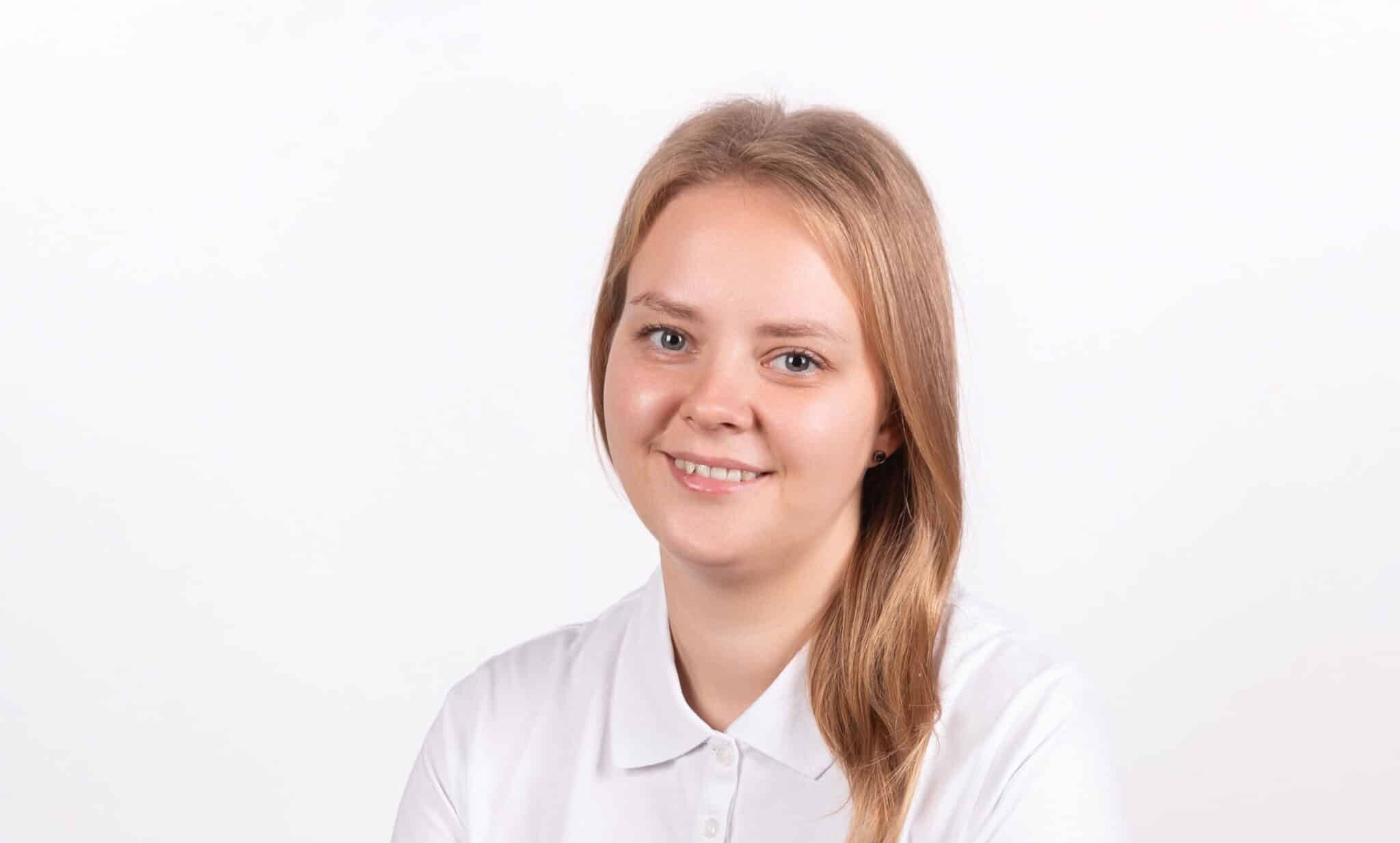
For almost ten years now, Anastasia Kozlenko has grown alongside UHY Prostir. She joined the company as a first-year student for the position of accountant’s assistant, and today she heads the payroll direction and manages a team of specialists.
In this interview, we spoke with Anastasia about her first steps in the profession, the specifics of payroll processes, working with a team, and the challenges of a leadership role. We also talked about how persistence, a desire to learn, and support from colleagues help build a career and find one’s place in the profession.
Nastya, share your story of starting to work at UHY Prostir. What were your first impressions of the company?
I remember my start at the company quite well. I was very nervous, since I had just finished my first year of my bachelor’s degree and had only basic knowledge of payroll calculation. At the same time, I had a great desire to learn and gain practical experience. What I remember most is the atmosphere at the company — friendly, welcoming, open, and at the same time professional. From the very first days I felt colleagues’ readiness to help and share knowledge, and that was very supportive.
You began your professional path at UHY Prostir while still studying. What was your first role at the company, and what was hardest at the beginning?
I came in for the position of accountant’s assistant. My first job involved organizing documents, forming registers, and processing documents in accounting systems. Later I joined the team preparing reporting.
The hardest part was figuring out professional terminology, accounting entries, and specialized software, since we hadn’t yet studied these topics in first year. I took notes on every process down to the smallest detail, so that at any moment I could go back to my notes and reproduce the necessary sequence of actions.
In effect, UHY Prostir became a wonderful school of accountant life for me. Later, in lectures, it was easier for me to understand the material, since I had already gone through most of it in practice.
How did your understanding of the accounting profession change over time? What was the biggest discovery for you in this field?
At the beginning, it seemed to me that accounting was mostly about documents, numbers, and reports. Over time I understood that it’s much more than that. An accountant needs to understand business processes, legislation, risks, and client needs. It’s important not just to correctly record a single transaction, but to understand its essence and its impact on the company’s activities as a whole. The biggest discovery was how important analytics is, and the ability to see the connection between different processes.
Over the years you’ve had the chance to work on various projects and directions. What experience helps you most today in your role as team leader?
The most valuable thing for me was the experience of working with different projects. It taught me to look at tasks more broadly, to see not just a single operation, but the whole process as a whole.
Over time I also came to understand that a way out can always be found, even from the most difficult situation. My managers and colleagues, whom I could always turn to for help, were a great support to me in this.
Now, in my work, I try to build an approach where members of my team aren’t afraid to ask questions and seek help, but instead learn and grow. It’s equally important to me to create a favorable environment for everyone’s professional growth.
When did you realize that payroll was exactly the area you were interested in developing more deeply?
Even while studying at university, I was interested in the topic of wages and taxation. Later, at work, I joined a large payroll project. It was hard at first, but over time I realized this was mine.
Payroll is a very meticulous and responsible field. But I get satisfaction from the process of work itself, and especially when a client positively evaluates the results of our work. Besides that, working with payroll really strengthened my analytical skills. It’s a field where everything has to add up perfectly. If something doesn’t add up, you need to figure out the reasons, find a solution, and eliminate the problem.
How do payroll processes differ from the traditional idea of accounting? What in this work requires special attention?
Payroll is directly connected to people, so even a minor error can have tangible consequences for an employee. That’s exactly why accuracy, meeting deadlines, and constant monitoring of legislative changes are especially important in this field. Besides that, payroll processes involve working with sensitive information, so a high level of confidentiality and responsibility is an integral part of the work.
Payroll is often connected to sensitive information: salaries, personal data, deadlines, and legislative changes. What principles are key for you in working with such processes?
For me, these are above all responsibility, confidentiality, and systematicity. It’s important to strictly follow established procedures, carefully check results, and ensure proper protection of information. Continuous learning is equally important, since legislation and requirements for payroll processes are constantly changing, and a specialist has to respond to these changes in a timely manner.
In your opinion, what is a sign of a well-built payroll process?
In my opinion, a quality payroll process works stably and predictably. It’s important to set clear deadlines and stick to them. As a rule, we agree on a payroll calendar once a year and then work according to it.
It’s equally important that all participants in the process clearly understand their roles, the sequence of actions, and the significance of meeting established deadlines. Besides that, all features and nuances should be recorded in instructions, so that every specialist involved in the process can familiarize themselves with them and act according to a clear algorithm.
Another important feature is automation. It helps optimize working time and reduce the risk of errors related to the human factor.
Your team works in various formats, including one colleague who works fully remotely. How do you manage to maintain effective communication and team engagement in shared processes?
For me it’s important that every team member has access to necessary information and understands current priorities. We regularly discuss work matters, use shared tools for planning tasks, and maintain constant contact. Besides that, when launching new projects, we record our meetings and build a training base. This makes it possible to go back to needed information at any moment, review or listen to the material again, and confidently carry out assigned tasks.
You yourself started your career at the company as a student. Does this experience affect how you support newcomers on the team today?
It definitely affects it. I remember myself in their place, so for my part I try to provide as much information as possible when bringing people into new processes. At the same time, getting familiar with new tasks happens gradually and in measured doses, to avoid information overload.
I remember well how important it is at the start to have support and the opportunity to ask questions. So I try to create an environment where beginner specialists can comfortably learn, gradually take on responsibility, and not be afraid to ask for help.
What qualities do you value most in the people you work with?
I value honesty, responsibility, the desire to understand the process rather than mechanically execute tasks, attention to detail, and the ability to work in a team the most. It’s also important to me that a person is ready to take initiative and look for solutions, rather than just noting a problem.
What is currently the biggest challenge for you in the role of payroll team leader? And on the other hand, what motivates you most in this role?
The biggest challenge is ensuring stable quality of work amid constant changes and growing task volume. What motivates me most is the team’s development, the opportunity to improve processes, and seeing the results of joint work.
At the beginning of your career, how did you envision your professional development, and what helped you most along this path?
At the beginning, I was focused primarily on doing my work well, constantly learning, and improving my skills. I wanted to grow and overcome new challenges, no matter how difficult they were.
Looking back, I understand that persistence, willingness to work through difficult cases, responsibility, colleagues’ support, and management’s trust helped me the most.
How do you see the further role of the payroll team in the company’s development?
Above all, it’s the automation and optimization of payroll processes. This approach will help reduce the time spent on operational work and allow more attention to be devoted to consulting and working directly with clients.
What would you advise someone who is just starting a career in accounting or payroll?
Don’t be afraid to ask questions, pay attention to detail, and keep learning continuously. It’s impossible to know everything from day one in this field, but the desire to develop and willingness to work on yourself always pay off.
And finally: what does “being in your place” in the profession mean to you?
For me, being in my place means getting satisfaction from the work and understanding that my work has value. It’s that feeling when you take on new challenges with pleasure and see meaning in your work every day.
Interview by Kateryna Bohdan
Related Interviews
- Not Giving Up and Always Believing in Yourself: A Conversation with Natalia Pinchuk on Career Path and Values (⚠️ вставити реальний URL)
- On Expertise, Responsibility, and Team Development: Interview with Larysa Sternyuk (⚠️ вставити реальний URL)
- How the Auditor of the Future Thinks: Interview with Viktor Safinsky, Head of UHY Prostir’s Audit Direction (⚠️ вставити реальний URL)
- How Innovation Is Changing Accounting Outsourcing: Interview with Natalia Lytvynenko, Chief Innovation Officer (CIO) at UHY Prostir
Frequently Asked Questions About Payroll Processes
What is a payroll process and how does it differ from regular accounting?
Payroll is a field directly related to calculating employees’ wages. Unlike general accounting, here even a minor error has a direct, tangible impact on a specific person, so accuracy, meeting deadlines, and constant monitoring of legislative changes play a key role.
What are the signs of a well-built payroll process?
Stability and predictability of work, a clear payroll calendar with deadlines, clearly understood roles for all process participants, nuances recorded in instructions, and automation of routine operations to reduce the risk of human error.
How is confidentiality ensured when working with payroll?
Working with payroll involves access to sensitive information — salaries, personal data, deadlines. Key principles: responsibility, confidentiality, systematicity, strict adherence to established procedures, and careful verification of results.
Do legislative changes affect payroll processes?
Yes, legislation and requirements for payroll are constantly changing, so specialists must continuously learn and respond to new requirements in a timely manner — this is one of the key principles of quality support.
How does the payroll team work with clients in a remote format?
The team uses shared tools for planning tasks, maintains constant contact, and for new projects records meetings and builds a training base — this makes it possible to return to needed information at any time.
What is the outlook for the development of the payroll direction?
The main direction is the automation and optimization of processes, which will reduce the time spent on operational work and allow more attention to be devoted to consulting and direct client work.