
Every business needs to set up an effective system of work and interaction between the employer and employees. It is important to note that this process starts with properly formalizing the employment relationship. Employment relationships play a key role in today’s society and economy, because they form the basis for the parties’ joint work.
In this article, we will look at:
- the main aspects of employment contracts;
- the specifics of fixed-term employment contracts, including their advantages, disadvantages and legal status;
- the conditions for concluding and terminating fixed-term employment contracts.
Our firm provides a legal review of contracts and payroll and HR administration services.
What an employment contract is
An employment contract is an agreement between the owner of a company (or an authorized person) and an employee. Under this agreement, the employee undertakes to do the work defined in it, and the employer undertakes to pay the employee a salary and to provide the working conditions that are necessary and required by law.
Types of employment contracts
There are three types of employment contracts:
- a standard employment contract;
- a contract (kontrakt, a special form of employment contract);
- a simplified employment contract (valid during martial law).
Let us look at each of these types in more detail.
A standard employment contract can be concluded with any employee, orally or in writing. In terms of duration, it can be fixed-term or open-ended.
A contract (kontrakt) is concluded with the categories of employees for whom a special law provides for it (in particular, part 3 of Article 21 of the Labor Code of Ukraine). It can be oral or written, and in terms of duration, it is always fixed-term.
A simplified employment contract is valid for the period of martial law in Ukraine and can be concluded with employees if one of two conditions is met:
- the employee’s monthly salary is more than 8 times the minimum wage;
- the employer is a small or medium-sized business with an average of no more than 250 employees per year.
It can be oral or written in form if it contains terms that differ from the general terms set by law.
There is also an employment contract with non-fixed working hours. This is a special type of contract that does not state specific working hours. The employer decides when the employee is needed for work and how much work there is. The employer also agrees with the employee on the work schedule and on the working hours needed to do this work within the period set in the employment contract. The legal requirements on working hours and rest time must still be met.
The number of employment contracts with non-fixed working hours that one employer has may not exceed 10 percent of the total number of employment contracts to which this employer is a party. An employer with fewer than 10 employees may conclude no more than one employment contract with non-fixed working hours.
An important point when concluding any of these types of contracts is to set their duration. Let us look in more detail at a fixed-term employment contract between an employee and an individual and at its specifics.
How to conclude an employment contract
To conclude an employment contract, the employee must submit the following documents:
- a passport or another identity document;
- an employment record book (trudova knyzhka, the official record of a person’s employment history);
- the taxpayer registration number (tax identification number).
In cases provided for by law, the following may also be needed:
- documents on education (profession, qualification);
- a medical certificate, for example, for persons under 18, for physically demanding work, for work that requires professional selection or for work that involves serving the public. Such persons are hired only after they submit a document with the results of a medical examination and a conclusion that they can do the work offered;
- other documents, for example, researchers may submit a list of their published works.
The employee must either write an application for employment or sign a written employment contract. If the employment contract is concluded in writing, no application is needed. If the employment contract is concluded orally, the basis for the internal order on hiring is the employee’s application. It is usually handwritten on a standard A4 sheet of paper or on a pre-printed form.
Advantages and disadvantages of a fixed-term employment contract
A fixed-term employment contract is concluded when the employment relationship cannot be established for an indefinite period because of the nature of the work, the conditions of the work, the employee’s interests or in other cases provided for by law.
The main features of a fixed-term employment contract:
- the minimum term of the contract can be 1 day, and the maximum term is not set;
- a probation period can be set if the fixed-term employment contract is concluded for one year or more;
- annual leave, additional leave and sick leave are granted on general terms;
- the employee cannot resign at their own request without a good reason;
- the contract can lawfully be extended if an open-ended employment contract cannot be concluded.
Advantages of a fixed-term employment contract:
- replacing an employee who is temporarily absent;
- hiring employees for seasonal or temporary work;
- establishing employment for a fixed period in the employee’s interests (for example, because of family circumstances or for the period of the employee’s internship or studies);
- formalizing employment relations with foreign nationals;
- all social guarantees from the employer are fully kept (an official salary, paid leave, sick pay, compensation on dismissal).
The disadvantage of a fixed-term employment contract is that the employment relationship ends after the agreed term. In addition, some employers sometimes use a “labor agreement” (trudova uhoda) instead of an employment contract. Since the concept of a labor agreement does not exist in the law, the employer bears no liability if incidents occur.
Employees often sign an appendix to the hiring order rather than an employment contract. An employer’s order, as an official document, guarantees all the same rights and freedoms as an employment contract, but there is one important detail. The employer can change the working conditions at any time: the salary, duties, working hours and working days, or register the work as a secondary job. All of this will be lawful, because the careless employee gave the employer these privileges by signing such documents.
How to extend a fixed-term employment contract
By mutual agreement, the parties can add to and amend a fixed-term employment contract, including before it expires.
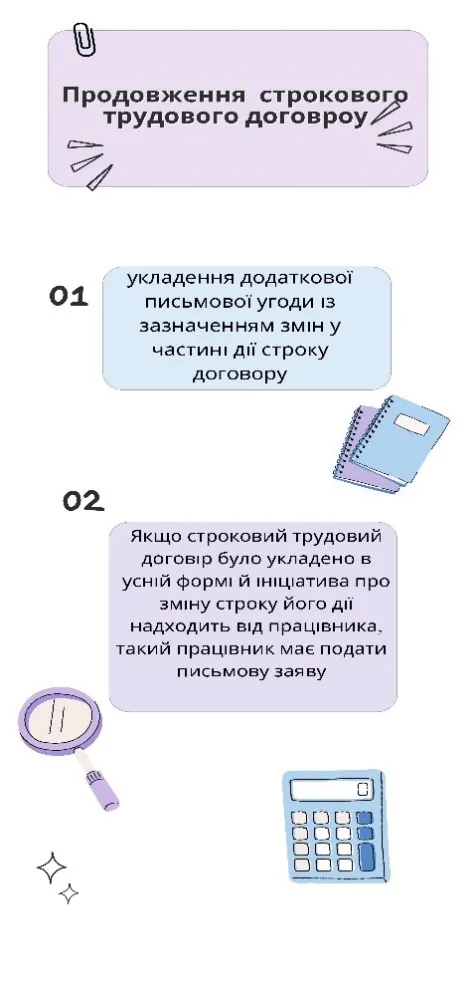
To amend the hiring order with regard to the term of the employment contract, a new order on these amendments must be issued, whatever the form of the employment contract (oral or written).
If only the term of the employment contract is extended, an order to extend it is issued on the employee’s last working day under the fixed-term contract. It is based on an addendum to the contract or on the employee’s written application.
If the employment relationship actually continues after the employment contract expires and neither party demands that it end, the contract is considered extended for an indefinite period (under Article 39-1 of the Labor Code).
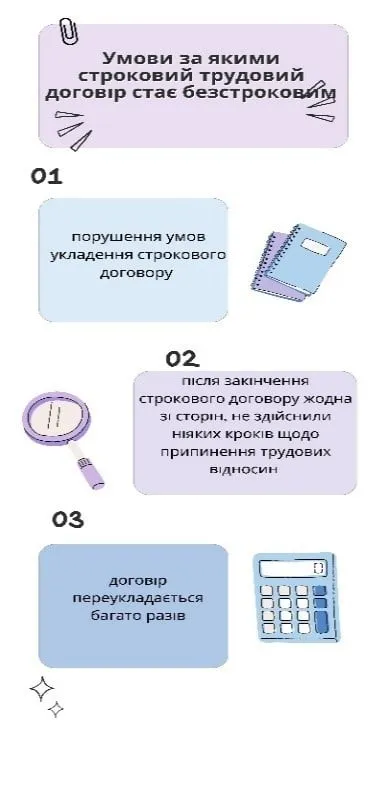
To avoid risks, be careful when you extend or renew fixed-term employment contracts. Do not let a situation arise in which the same employees are regularly dismissed and hired again to perform the same job function.
In such a case, a court may find that the employment contract was concluded for an indefinite period from its first day.
How to make an entry about a fixed-term employment contract in the employment record book
Under Instruction No. 58, the employment record book does not show the terms of the employment contract: working hours, work schedule, pay, hiring conditions (a fixed-term employment contract or a kontrakt) or whether there is a probation period.
So, when a person is hired, the entries in the employment record book look like this:
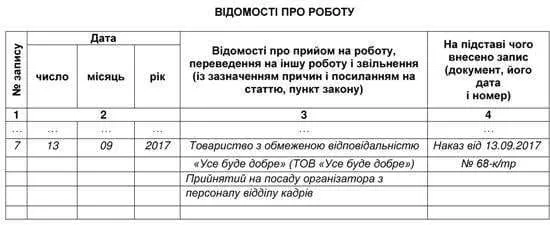
Sometimes the hiring conditions can be seen from the dismissal entries. For example, a fixed-term employment contract is terminated on the basis of:
- clause 2 of Article 36 of the Labor Code of Ukraine;
- clause 8 of Article 36 of the Labor Code of Ukraine (breach of the terms of a kontrakt);
- clause 11 of Article 40 of the Labor Code of Ukraine (an employee who did not pass the probation period).
How to draw up an order to extend a fixed-term employment contract
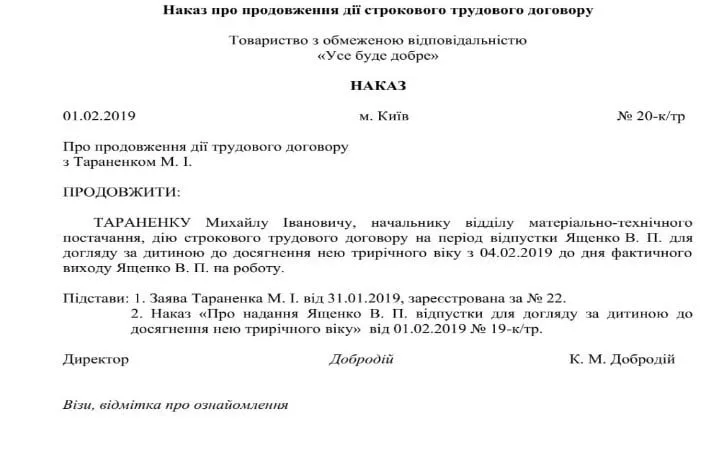
Below are examples of an application and an order to extend a fixed-term employment contract.
Example: Application to extend a fixed-term employment contract
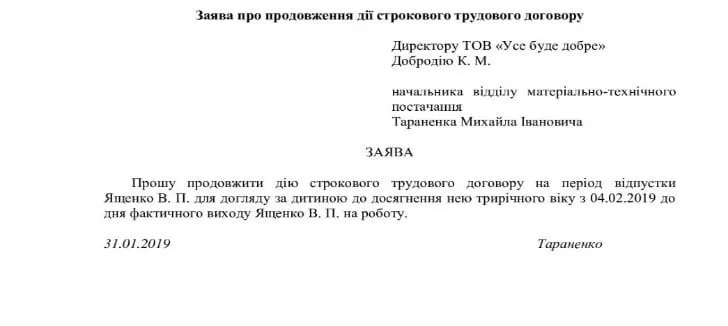
Example: Order to extend a fixed-term employment contract
Termination of an employment contract
During martial law, the law allows employers to suspend an employment contract temporarily without ending the employment relationship.
Suspension of an employment contract means that the employer temporarily stops providing the employee with work and the employee temporarily stops performing the duties under the employment contract. This can happen because of the military aggression against Ukraine, which makes it impossible to do the work.
Under Article 13 of the Law of Ukraine “On the Organization of Labor Relations under Martial Law”, either party may initiate the suspension of an employment contract. The suspension may not last longer than the period of martial law.
The employer issues an internal order to suspend the employment contract, which states:
- the reasons for the suspension;
- the period of the suspension;
- the list of employees concerned;
- the employees’ taxpayer registration numbers (RNOKPP);
- the conditions for resuming the employment contract.
The employer must make sure the employee reads the suspension order and must agree with the employees on a way of communication that is acceptable to all parties.
How a fixed-term employment contract can be terminated
A fixed-term employment contract ends on the last day set in it. It can also be terminated early at the request of one of the parties and in other cases provided for by Article 36 of the Labor Code. The dismissal order is issued on the last day of the fixed-term employment contract or the day before. It states the dismissal date that follows from the term of the employment contract.
The owner or an authorized person may dismiss the following employees because their employment contract has expired only if they are given another job: pregnant women, women with children under 3 and single mothers with a child under 14 or a child with a disability. In this case, they must continue to receive their average salary for three months after the fixed-term employment contract expires.
An employee cannot terminate a fixed-term employment contract on their own initiative by giving the employer 2 weeks’ notice. This option exists only when the contract is concluded for an indefinite period.
Grounds for terminating a fixed-term employment contract
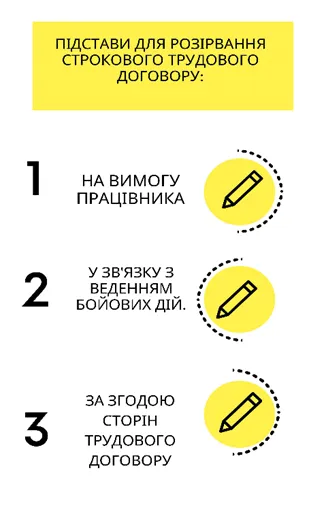
The grounds include the employee’s illness or disability that prevents them from doing the work under the contract, the employer’s breach of labor law or of the collective or employment agreement. They also include the cases provided for by part 1 of Article 38 of the Labor Code.
If there are hostilities in the areas where the company is located and there is a threat to the employee’s life and health, the employee may terminate the employment contract on their own initiative within the period stated in their application.
The parties to an employment contract may agree to terminate it early.
Conclusions
From the information above, we can conclude that a fixed-term employment contract is indeed an important tool for regulating employment relations. It gives a significant number of advantages to both parties: the employer and the employee.
It guarantees all the social conditions that an open-ended employment contract provides. It is also ideal for project, seasonal and temporary work and for replacing employees who are temporarily absent.
Given the legal and practical aspects, fixed-term employment contracts help make employment relations flexible and stable. They also protect the interests of both parties: the employer and the employee.
Answers to frequently asked questions
- When is an employment contract considered concluded?
An employment contract is considered concluded from the moment the parties have agreed on all essential terms and the employee has started work. Under Article 24 of the Code of Labor Laws of Ukraine (KZpP), an employment contract is, as a rule, concluded in writing.
- When does a fixed-term employment contract become open-ended?
A fixed-term employment contract may become open-ended if the employment relationship actually continues after the contract expires and neither party demands that it end. This is provided for by Article 39-1 of the Labor Code of Ukraine.
- Who concludes an employment contract, and what should it contain?
An employment contract is concluded between the employer (or its representative) and the employee. Its content is determined in line with Article 21 of the Labor Code and must cover the following main terms: the place of work, the job function (position, profession, qualification), the duties of the employer and the employee, pay, working hours, rest conditions (leave), etc.
- What is the main term of an employment contract?
The main term of an employment contract is the parties’ agreement that the employee will perform a certain job function (work) in exchange for a salary. Another important term is compliance with labor law, the collective agreement (if there is one) and the company’s internal regulations.
- Where is the employment contract kept?
The employment contract is kept by the employer. The original must be kept in the HR department or another responsible unit of the company. If the employment contract is concluded in writing, one copy is given to the employee and the other stays with the employer.
References
- Code of Labor Laws of Ukraine (KZpP)
- Law of Ukraine No. 2136 “On the Organization of Labor Relations under Martial Law” dated July 19, 2022
- Article 42 of the Law of Ukraine “On Employment of the Population” dated October 14, 2023, No. 5067-VI
- On approval of the Instruction on the Procedure for Keeping Employees’ Employment Record Books No. 58
Abbreviations used in the text
KZpP — Code of Labor Laws of Ukraine (the Labor Code)
MZP — minimum wage
Aliona Sydorkina
Project Manager