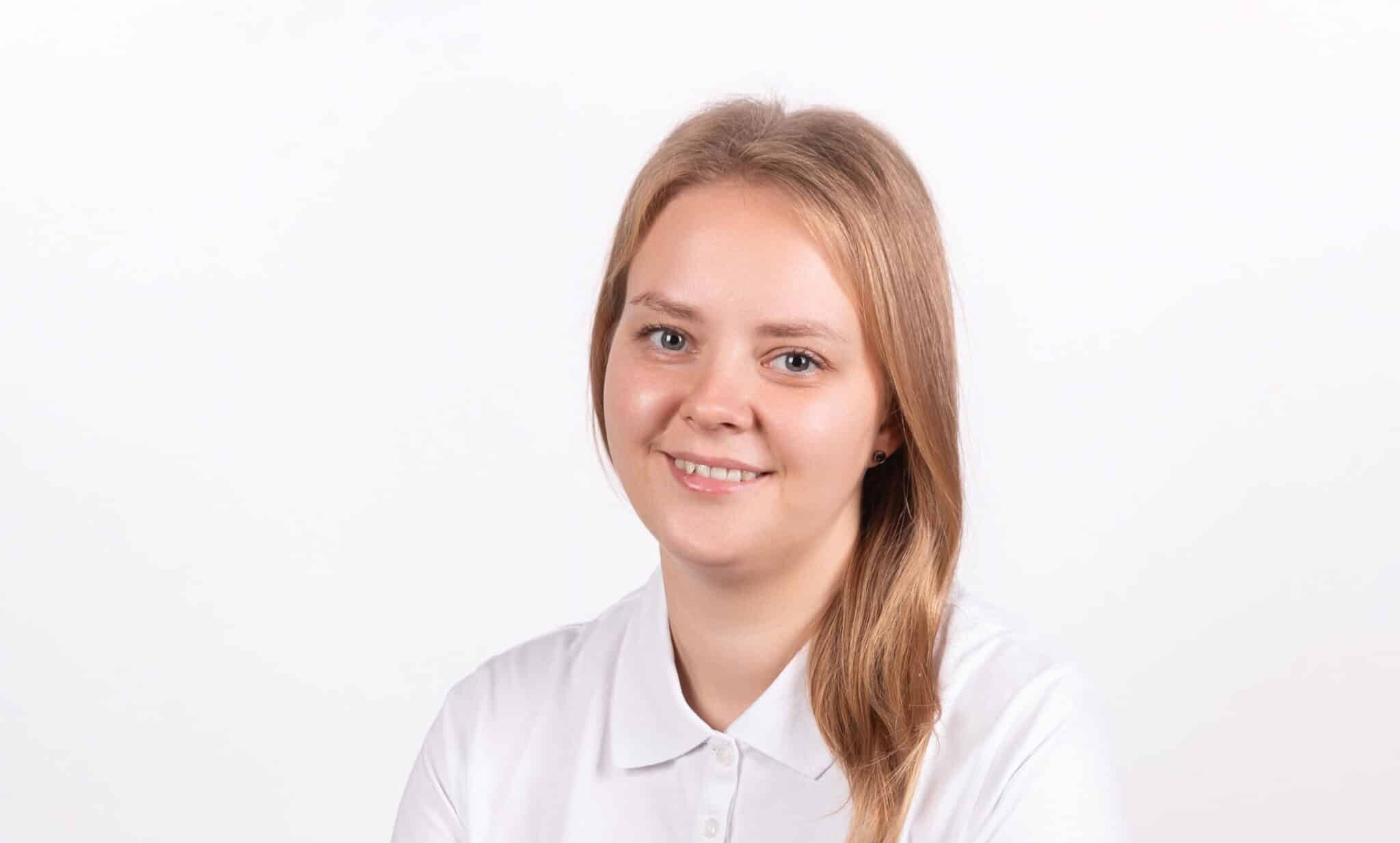


A professional career in accounting often begins with basic tasks and gradually develops into more complex roles, where not only accounting knowledge matters, but also systemic thinking, responsibility, and the ability to work with people and processes. With the development of technology and automation, this transformation is only accelerating, changing both the profession itself and expectations of specialists.
In this interview, we spoke with Anna Korzh, Project Manager at UHY Prostir, about her career path — from assistant accountant to a role that combines expertise, management, and client interaction. We discussed how the role of the accountant is changing today, which processes often remain behind the scenes but critically influence results, and which skills help professionals grow in a constantly changing environment.
Anna, how did your professional journey in accounting begin, and how did you join UHY Prostir?
My career in accounting began in January 2015, when I was a third-year student at the Faculty of Enterprise Economics. After studying accounting, I decided to try myself in the profession. I started looking through vacancies for assistant accountant positions, sent my CV to several companies, and that is how I got my first job as an assistant accountant in an audit company.
After working there for a year, I realized that I wanted a change and saw my professional development in a different environment. While looking for new opportunities, I joined UHY Prostir — also as an assistant accountant. My first working day was March 1, 2016 — the first day of spring. For me, it became a symbolic start of a new stage and a sense of renewal, which felt very meaningful at the time.
You have been working at the company for almost 10 years. How has your role and responsibility changed during this time? Which stages of this journey were the most defining for you?
Over the years, my role in the company has changed gradually: from assistant accountant to accountant, then to expert accountant, and since 2020 I have held the position of project manager.
One of the first defining stages for me was the transition to the position of accountant in autumn 2016 — about six months after I started working at the company. This meant not only an expansion of my functions, but also a change in the level of responsibility: I became responsible for maintaining clients’ accounting records and at the same time began working with assistants — distributing tasks and checking the results of their work.
At that moment, the offer felt like a real challenge. It seemed that it had happened even faster than I expected. I was nervous, but still decided to accept the opportunity, and later I never regretted it.
The transition to the project manager role was more intentional. By then, I already felt ready for new challenges and greater responsibility, although, of course, there was still some excitement.
Which project manager tasks most often remain “behind the scenes” but are actually critically important for the stable work of projects?
There are many tasks that remain “behind the scenes,” but they are exactly what ensure project stability.
First of all, it is the clear formulation of tasks — a kind of “translation” from the client’s language into the accountant’s language, so that the team correctly understands the request and can implement it properly.
It is also important to constantly monitor the status of tasks: check progress on time, clarify details with the team or client, and prevent processes from “falling through the cracks.” Another key aspect is maintaining the “big picture”: understanding what is happening on the project, how processes are connected, and whether there are potential risks — both at the current moment and in the future.
If you had to explain the role of a project manager in accounting outsourcing to someone outside the profession in one sentence, what would you say?
A project manager in accounting outsourcing is the main contact person for the client during accounting support and organizes the work of the team to ensure that accounting services are provided with high quality and on time.
Are there any decisions or approaches that once seemed complicated or unusual, but have now become standard practice?
Yes, there are several approaches that initially felt unfamiliar, but with the company’s growth they became necessary and quickly turned into standard practice.
One example is work calendars for each client, with clear deadlines and visibility of each team member’s workload. This helps plan work more effectively and avoid overload.
Another example is detailed instructions for large client processes. They help structure the work, maintain consistent quality, and make it easier to transfer tasks between team members.
Automation is now actively changing accounting processes. How do you see this transformation from the perspective of someone who coordinates the work of a team?
Automation is significantly changing accounting processes. From a manager’s perspective, I see several key benefits.
First, it reduces the time needed to complete tasks. This helps optimize the team’s workload and also allows us to deliver results to clients faster.
Second, it lowers the risk of errors, which directly improves the quality of work.
Third, automation makes it easier to transfer processes between team members. A new specialist can understand and take over tasks more quickly, which makes the team more flexible and more resilient to change.
Does the role of the accountant change when part of the operations is taken over by a system or digital tools?
Yes, automation significantly changes the role of the accountant. It makes it possible to substantially reduce the volume of routine tasks that were previously performed manually and took up a large part of working time. As a result, the focus of work shifts: instead of repetitive operations, the accountant pays more attention to controlling the correctness of data reflected in the system and analyzing processes.
Which accounting processes, in your opinion, are the most difficult to automate and why?
The most difficult processes to automate are those that require understanding context, professional judgment, and interaction with people. In particular:
- client communication — both in terms of clarifying transaction data and understanding expectations and business context;
- interpretation of non-standard transactions, such as atypical business operations and complex contracts;
- final verification of how transactions are reflected — identifying technical errors and inaccuracies;
- tax planning — choosing approaches and methods for reflecting transactions within the framework of legislation;
- process management — setting tasks, controlling deadlines, prioritizing, and working with risks.
These tasks are connected less with technical skills and more with analytical thinking, experience, and communication — in other words, with competencies that are difficult to fully automate.
Does automation help reduce the workload on the team, or does it simply change the nature of the work?
Automation not only changes the nature of work by taking over routine tasks, but also truly reduces the workload on the team. If we imagine the volume of document flow we work with today without automation, it would require significantly more time and human resources. That is why such tools do not simply optimize processes — they make scaling possible.
Which accounting processes have benefited the most from automation, or will benefit in the near future?
Yes, there are already processes that benefit significantly from automation. In particular:
- processing primary documents — this is the most large-scale process, and AI tools already cover about 80–90% of the work related to data entry;
- processing bank statements — also a regular and labor-intensive process that is significantly optimized through automation.
In the near future, I believe the key development area will be the improvement of AI tools in detecting duplicates, recognizing non-standard transactions, and more accurately categorizing expenses and income.
Which skills are becoming more important for accountants in the context of process automation?
In the context of automation, the focus of an accountant’s work is changing: there are fewer manual operations, while the need for analysis is increasing. It is necessary to be able to identify deviations, detect errors, and work on eliminating them. That is why soft skills are becoming especially important: critical thinking, systemic vision, and proactivity. At the same time, they must be combined with a strong foundation of hard skills — knowledge of accounting principles, including legislation, standards, and tax regulation, as well as an understanding of how accounting systems work and what automation capabilities they offer.
Communication, flexibility, and readiness for continuous learning should also be highlighted separately — these skills are becoming critically important in conditions of constant change.
What brings you the greatest professional satisfaction in your work?
I genuinely enjoy being a manager — this role always involves dynamics and a variety of tasks.
First, it is the constant change of focus — from operational issues to more strategic planning, as well as regular interaction with the team and clients. Second, I enjoy working with complex tasks — breaking them down into clear components and gradually bringing them to completion.
The final outcome brings particular satisfaction: when business operations are properly documented for all participants in the process, reporting has been submitted, taxes have been paid — and you clearly understand your contribution to this result.
And, of course, it is important that the field is constantly changing. This dynamic gives a sense of both professional and personal growth.
Was there a moment in your practice when, after a difficult project or situation, you thought: “This is exactly why I love my work”?
For me, it is probably not one specific moment, but rather a recurring experience.
I am one of those people who often agree to take on tasks that initially seem like a challenge and look quite difficult. During the process, they may be demanding, but after completion there is always a feeling of growth and satisfaction with the result. It seems to me that professional development is formed precisely through such challenges — when you step beyond what is familiar and see that you are capable of more than you initially thought.
Teams often include people with different approaches to work. In your opinion, how can these differences become an advantage rather than a source of conflict?
People are indeed different, and their approaches to work can also differ significantly. That is why one of the key tasks of a manager is to understand the characteristics of each team member and apply them correctly. Where these differences can work for the common result, it is important to strengthen them. Where they may create difficulties, it is important to discuss them openly and look for solutions. In this context, open communication is critically important.
In fact, diversity is an advantage. For example, someone may be fast and flexible, while someone else works more slowly but with great attention to detail. Such people can be effective in different types of tasks and processes.
A strong team is not about everyone being the same, but about different people who complement each other and work toward a common result.
What, in your opinion, has the greatest impact on the atmosphere within a team?
The atmosphere in a team is largely determined by the style of interaction between people. It is about whether people can openly express their opinions, ask questions when something is unclear or difficult, whether initiative can be shown and whether it is encouraged, whether everyone understands their role and feels their contribution to the overall result, and also how the manager reacts when something does not go according to plan.
What mistakes do people most often make at the beginning of their accounting career?
At the beginning of a career, many people feel uncertain — and that is completely normal. However, because of this, people are often afraid to ask questions, which can lead to wasted time or mistakes in work. Therefore, one of the key pieces of advice is not to be afraid to clarify details and ask for help when something is unclear.
Another common mistake is the lack of a second review of one’s own work. Due to lack of experience, newcomers sometimes do not analyze the result comprehensively, which can lead to inaccuracies.
What would you have liked to know about the accounting profession at the very beginning of your journey?
I was also a newcomer once, and perhaps the most important thing I would have liked to hear at the start is that asking questions is not a weakness. On the contrary, it is better to clarify details and ask someone to check the result when there are doubts — this makes the work easier both for you and for the person who receives it.
It is also important to understand that legislation changes very often, so continuous learning is a necessity in this profession. In addition, the profession itself is transforming: from the very beginning, it is worth being interested in process automation and understanding the capabilities of accounting systems.
And one more thing — at the start, there really are many routine tasks, but over time, more and more complex and interesting processes open up, creating opportunities for professional growth.
Interview by Kateryna Bohdan
-
Never Give Up and Always Believe in Yourself: A Conversation with Nataliia Pinchuk on Career Path and Values
-
On Expertise, Responsibility, and Team Development: An Interview with Larysa Sterniuk
-
The Mindset of a Future Auditor: An Interview with Viktor Safinskyi, Head of Audit at UHY Prostir
-
How Innovation is Changing Accounting Outsourcing: An Interview with Nataliia Lytvynenko, Chief Innovation Officer (CIO) at UHY Prostir