Artificial intelligence is gradually becoming an essential part of modern business processes. A few years ago, many people saw it as an experimental technology. Today, it is a powerful tool for automating routine processes, improving efficiency and reducing operational risks.
But what is an AI agent in practice? Which tasks should you delegate to it? How can you implement it with minimal risk? And can artificial intelligence really replace professionals?
In this article, we look at a practical approach to implementing an AI agent in a company. It is written for business owners, CEOs, CFOs, finance managers, chief accountants and everyone who is responsible for financial processes and wants to use modern technology to grow the business.
What an AI agent is and how it differs from a chatbot and RPA
An AI agent (Artificial Intelligence Agent) is a tool based on artificial intelligence that can perform individual business processes, partly or fully, without constant human involvement. Put simply, it is a “digital assistant” that can analyze information, interact with systems, perform tasks according to set rules and help automate routine work.
AI agents can:
- collect and structure data;
- analyze documents;
- check information;
- send messages;
- trigger certain actions in other systems.
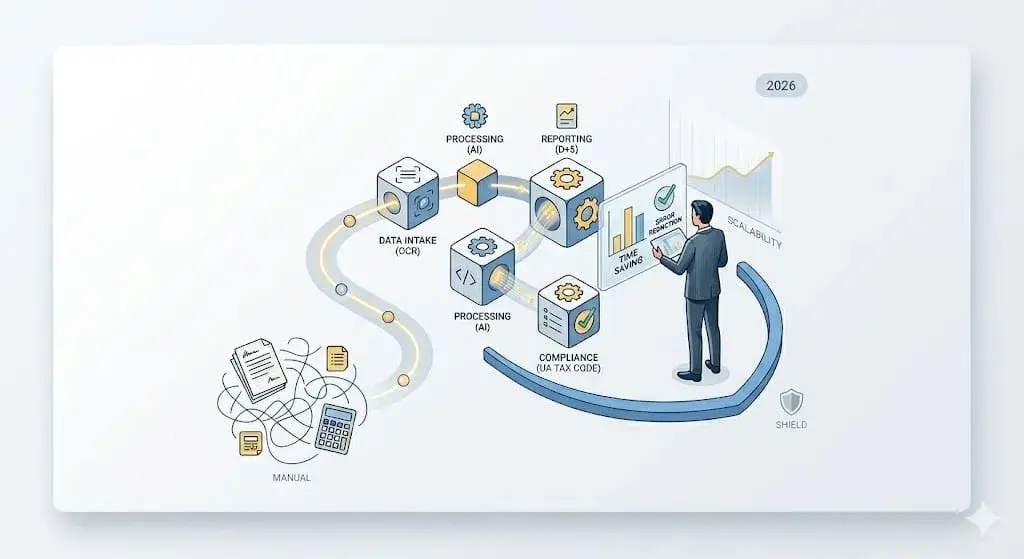
For example, in accounting, an AI agent can process source documents, check data for errors and help prepare some of the reports. Many companies are working on exactly these kinds of solutions today, including UHY Prostir.
It is important to understand the difference between three concepts:
- An AI chatbot answers questions in a dialogue, but it takes no action outside the conversation.
- RPA (Robotic Process Automation) automates clear, repetitive actions according to a set scenario, but it “freezes” if a situation goes beyond the script.
- A full AI agent combines both approaches. It analyzes information, makes decisions within the logic it has been given, interacts with different systems and performs part of the business processes on its own.
In short: a chatbot answers, RPA performs actions according to a predefined scenario, and an agent analyzes information and acts according to the logic it has been given. This is why companies are increasingly using AI agents as a practical tool to improve efficiency in accounting, finance, HR and other business functions.
Why are accounting, audit and payroll the most promising areas for AI?
Accounting, audit and payroll are among the most promising areas for AI agents. The reason is that a large part of the work in these areas consists of repetitive, structured and regulated operations. These operations require high accuracy and the processing of large amounts of data.
AI agents already help effectively with:
- initial document processing and the recognition of invoices and acceptance certificates;
- checking accounting data for errors and reconciling data between systems;
- preparing reports and tax documents;
- payroll calculations and the accrual of payments;
- auditing large volumes of transactions, namely detecting anomalies and inconsistencies;
- internal process monitoring and compliance.
At the same time, implementing AI does not mean replacing accountants, auditors or payroll professionals. On the contrary, technology makes it possible to reduce routine work and focus on tasks where professional expertise, analytical thinking and management decisions matter most. In practice, an AI agent can take over 60–80% of standard operations, while professionals will spend more time on control and on analyzing non-standard situations. This is the main value of the technology: not to replace people, but to strengthen what they can do and make their work more efficient.
What the implementation process looks like: a step-by-step plan
It makes sense to treat the implementation of an AI agent as a separate project with a clear sequence of stages. A step-by-step approach helps reduce risks, assess the real effect of automation and gradually extend the solution to other processes.
Step 1. Analyze and describe your business processes
One of the most common mistakes when implementing artificial intelligence is to start by choosing a technology without first analyzing your own processes. But AI does not remove chaos from work. It only speeds up processes that are already clear, structured and standardized.
This is why the first step is to analyze your current business processes: how much work they require, how often they repeat and how high the risk of errors is. Processes that score high on these criteria are usually the best candidates for automation.
Once you have chosen such a process, you need to describe it in detail. At this stage, it is important to record:
- who performs each operation;
- in what order the steps are taken;
- which rules and control points apply;
- where delays or errors happen most often.
You should also standardize how the chosen process is performed. If the same task is done differently every time, automation will be much harder and its result less predictable. This structured description becomes the basis for setting up the AI agent and defining the logic of its work.
Step 2. Choose an AI solution and launch a pilot
It is best to start not with a large-scale rollout, but with one clearly defined process. For example, this could be processing source documents, checking data or automating payroll calculations.
A pilot project lets you test the technology in real conditions, measure the time and resources saved, identify risks and adjust the settings before scaling up. In many cases, the first results become visible within a few weeks.
When choosing an AI solution, assess several key aspects:
- the level of data protection and compliance with confidentiality requirements;
- the ability to integrate with the company’s existing systems, in particular ERP, CRM and accounting software;
- scalability and flexible settings;
- how well it meets the real needs of the business, not just the list of features shown in a presentation.
Step 3. Integrate with internal systems
If needed, the AI agent is integrated with the company’s internal IT infrastructure through APIs, ready-made connectors or dedicated integration platforms.
Depending on its tasks, the agent can:
- receive and check data from ERP systems;
- create tasks in the CRM;
- analyze documents in electronic document management systems;
- interact with Microsoft 365, Google Workspace and corporate messaging apps.
Step 4. Test and set up quality control
Before the agent goes live, you need to set rules for checking its results and thresholds for automatic decisions. For example, if the AI agent’s confidence level is below the set threshold, the task is automatically passed to the responsible employee for an additional check.
Step 5. Scale up and move to everyday operation
After a successful pilot, the AI agent can gradually take on other business processes. To keep it working reliably, it is important to appoint a responsible person, such as a process owner or an AI coordinator, who:
- understands the logic of the process;
- monitors the quality of the results;
- assesses how effective the automation is;
- coordinates the further development of the solution.
This approach helps ensure not only a successful launch of the AI agent, but also its long-term efficiency and practical value for the business.
Quality control
In accounting, finance and audit processes, accuracy and control are especially important. This is why an AI agent needs clearly defined review rules and constant monitoring of its work. Every action it takes must be documented, and its results must be available for review and analysis.
To ensure the right level of quality, it is advisable to:
- apply the “human in the loop” principle, where a qualified employee additionally checks critical operations or the final result;
- regularly track key performance indicators, such as the error rate, the speed of task completion and the number of exceptions;
- review the AI agent’s settings and rules when business processes change.
In processes that involve large amounts, legal consequences or non-standard situations, follow this principle: the AI agent prepares the result, and the responsible professional checks and approves it.
Remember that automation does not remove professional responsibility. On the contrary, it reduces routine work and leaves more time for tasks where professional judgment, analysis, client advice and management decisions are especially important.
Data security and confidentiality
When AI solutions are used in processes that involve financial, HR and other confidential information, security needs special attention. Artificial intelligence does create new risks, but with the right approach they can be managed effectively.
When integrating an AI agent, follow the basic principles of data protection. In particular, you should:
- apply the principle of minimum necessary access: give the AI agent only the data and rights it needs for specific tasks;
- encrypt data and control the exchange of information with external services;
- know exactly where the data sent to AI systems is stored and who has access to it;
- regularly check access settings and analyze the AI agent’s activity logs;
- train employees to work safely with automated systems, because human error remains one of the most common causes of data leaks.
Deploying the AI agent in a closed internal environment, that is, a corporate network isolated from external networks, can add another level of protection. This approach greatly reduces the risk of sensitive data leaks, while the system keeps its full functionality.
The economic effect of AI agents
One of the main benefits of AI agents is less time spent on routine operations and fewer errors. But the practical effect is not limited to higher operational efficiency. When AI solutions are set up and integrated correctly, they can create much broader value for a business.
The main benefits include:
- scaling up without a proportional increase in staff. The company can handle more operations without significantly increasing the number of employees;
- faster business processes. Tasks that used to take hours or even days can be done much faster, which helps management make decisions quickly;
- better analytics. AI can process large amounts of data, find patterns and signal potential risks or deviations;
- lower operating costs. Less time goes into mechanical tasks and fixing errors, which improves overall efficiency;
- better service quality. Professionals can focus on tasks that need professional judgment, analysis and direct work with clients.
Practical scenarios: where AI is already at work
Today, AI agents are gradually becoming part of everyday operations in companies across different industries. Below are a few common scenarios for using AI agents in business.
An AI agent for payroll
The agent collects the necessary data, checks that accruals are correct, prepares payroll sheets and notifies the responsible people about deviations or possible errors.
An AI agent for internal audit
The agent analyzes large sets of transactions to detect anomalies, duplicates and suspicious patterns and prepares a preliminary report for the auditor. This lets the auditor focus on assessing risks and analyzing material deviations rather than manually reviewing large volumes of data.
An AI agent for client service
The agent handles standard client requests, gives information on task status, sends deadline reminders and frees the team from routine communication.
The future of AI agents in professional services
AI agents are gradually becoming one more work tool that complements traditional business systems such as ERP, CRM and cloud platforms. In the coming years, their use will become common practice for companies in a wide range of industries.
At the same time, the key changes will affect not so much individual professions as the way work is organized. The share of time now spent on routine operations, manual checks and moving data between systems will gradually decrease. Instead, tasks that require professional judgment, analysis, advice and management decisions will become more important.
Kateryna Bohdan