On October 7, 2026, the online webinar “Financial and Documentation Support for Projects in Hospitals” took place as part of the Project Management School.
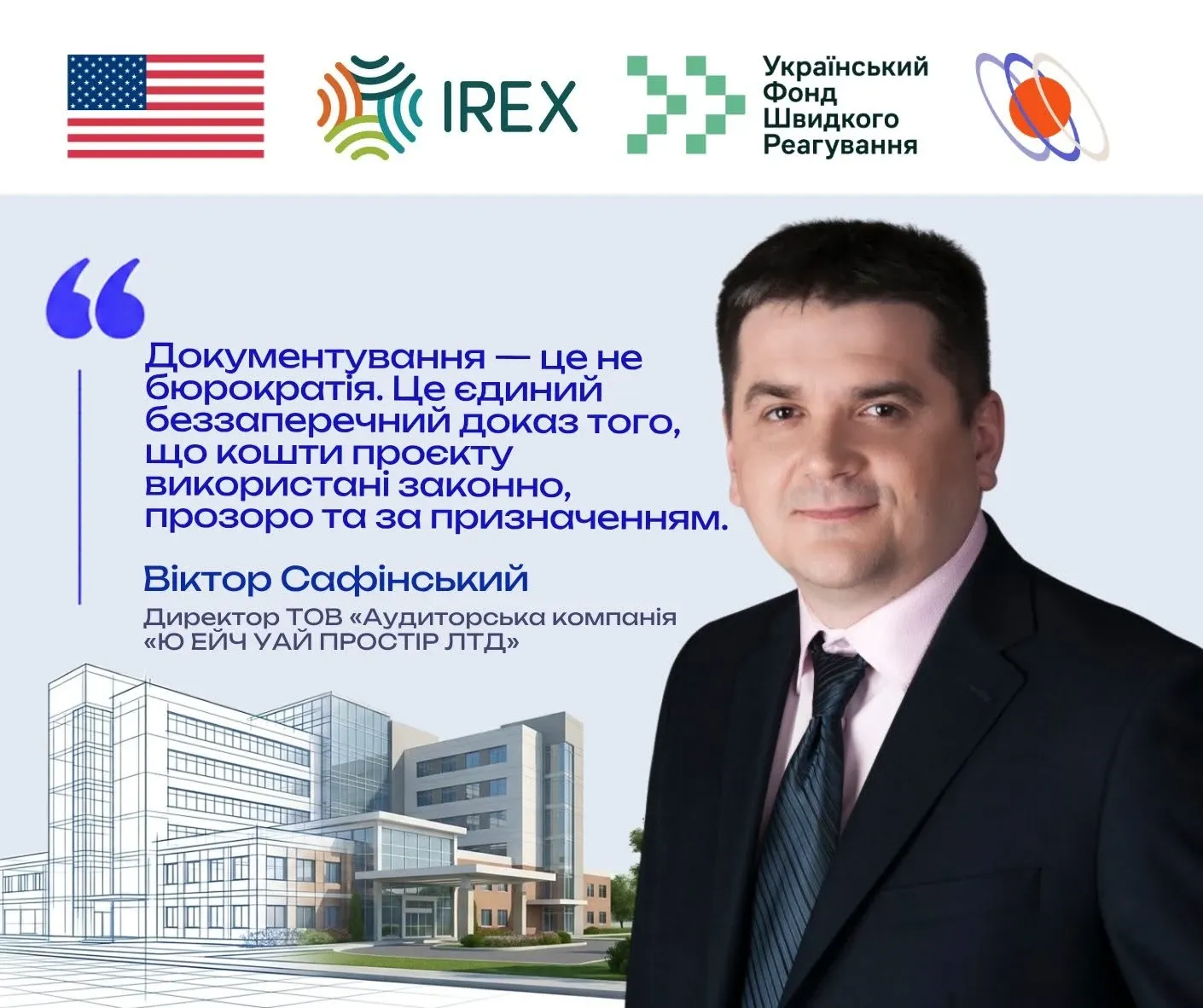
“Documentation isn’t bureaucracy. It’s the only indisputable proof that project funds have been used lawfully, transparently and for their intended purpose,” said the webinar speaker Viktor Safinskyi, Partner and Head of the Audit Practice at UHY Prostir and Director of LLC “Audit Company ‘UHY Prostir LTD’”.
During the session, Viktor discussed practical issues that arise when hospitals implement projects and work with donor funding. Here are the key takeaways.
Key takeaways from the webinar
- Correct accounting doesn’t make an expense eligible for the project. A hospital must comply with both Ukrainian law and the donor’s conditions: the grant agreement, the approved budget and the procurement rules. An expense has to meet both.
- The grant agreement determines indirect costs and VAT. It’s the agreement that sets which administrative and utility costs can be paid from the grant and in what share. A hospital’s tax status doesn’t mean the donor will accept value-added tax (VAT): if the grant doesn’t cover it, another source of funds is needed.
- Budget changes: approval first, payment second. If the price has changed, savings have appeared or a different item is needed, the change is approved by the donor before payment, not explained after it.
- Procurement must match the budget. The budget, terms of reference, specification, procurement procedure, contract and goods received must be consistent with each other. Whether to use Prozorro, Ukraine’s public e-procurement system, depends on the hospital’s status as a procuring entity and on the subject and value of the purchase. Medicines and medical devices are subject to separate rules under Resolution No. 1178 of the Cabinet of Ministers of Ukraine, and the donor may add its own requirements, such as three commercial quotes.
- A documentary trail confirms the intended use of funds. Payment alone isn’t enough to prove that funds were used for their intended purpose. Every significant expense must be backed by an unbroken chain of documents: from the budget and terms of reference to the contract, payment, delivery note, accounting records, actual use and report.
- Co-financing is legitimate; double funding is a violation. If the agreement allows it, a project can pay 60% of a purchase and the hospital or another donor 40%. But if the same purchase is reported in full to two donors, that’s double funding: the funds will have to be returned, and sanctions are possible. To avoid this, keep separate accounting records and codes for each project, and mark the grant agreement number and budget line on payment documents and acceptance certificates.
- Receiving equipment doesn’t mean putting it into operation. After the delivery note, the equipment is recorded in the accounts, installed, documented with a commissioning certificate, given an inventory number and assigned by order to an employee who’s financially responsible for it. A good test is whether, a year after the project ends, you’ll be able to show the donor where the equipment is, how it works and who uses it to treat patients.
- Medicines and medical devices are documented until they’re used. The donor cares not only about the purchase but about their whole movement: receipt, storage, transfer to a department, prescription to a patient and write-off. Balances in the accounting department and in the warehouse must match, and the quantities written off must match the prescriptions in patients’ medical records.
Four questions for every expense
To wrap up, Viktor suggested four questions to ask about every significant project expense:
- What was purchased — and whether it matches the budget and specification.
- Why — how the expense helps achieve the project’s goals.
- What it’s funded from — the grant, funds from the National Health Service of Ukraine (NHSU), the local budget or co-financing, with no risk of double funding.
- What proves it — the contract, invoice, bank statement, delivery note, commissioning certificate and order.
Such training helps hospital teams better understand the financial requirements of projects and work with donor resources more confidently.
The project is carried out by the Khab Sotsialnoho Rivniannia (Social Equation Hub) Charitable Foundation under the Ukraine Rapid Response Fund (URRF) program, which IREX in Ukraine implements with support from the U.S. Department of State.
Read more about the webinar in the joint post by the Khab Sotsialnoho Rivniannia Charitable Foundation and UHY Prostir Ukraine on Facebook.